
Echo Fuel Filter: The Right Number for Your Carburetor
The genuine in-tank fuel filter for current RB-carburetor Echo trimmers is 13120507320 (Walbro 125-527); older SRM-200-era machines use A369000000 instead. A partially clogged filter is the usual cause of a trimmer that idles fine but dies under throttle.
The in-tank fuel filter is the one part nearly every Echo troubleshooting guide mentions and almost none of them gives a number for. It is the small weighted cylinder sitting on the end of the fuel pickup line inside the tank, it clogs without any outward sign, and it produces the single most common complaint about Echo two-strokes: the engine idles fine and dies the moment you open the throttle.
This page is the number itself - which genuine filter fits which carburetor generation, and how to tell a clogged filter apart from the perished fuel line and primer bulb sitting right next to it.
The current filter: 13120507320
Echo's in-tank fuel filter for its current RB-carburetor trimmer range is genuine part 13120507320, confirmed across more than half a dozen independent listings and also sold inside Echo's own genuine 90008/90152/90152Y maintenance kit, bundled with the air filter 13031054130. It crosses directly to Walbro 125-527 (also listed 125-527-1), and the same physical filter sells again under 13120519830. Fitment spans the SRM-210, SRM-211, SRM-225, SRM-230, GT-200, GT-225, PAS-225, PE-200, PE-211, PB-200, PB-250 and the related HC-150/HC-151 - any Echo running the current 3/16 in fuel line on this engine family takes this filter.
It is not an Echo-only part either - several of the same listings name Stihl trimmers and backpack blowers alongside the Echo fitment, because the filter belongs to the Walbro carburetor's fuel-line spec rather than to either brand's badge - the same cross-brand pattern already documented on the Echo primer bulb page.
The older SRM-200 class takes a different number
Machines built around Echo's earlier carburetor generation use a different genuine filter, A369000000 (with the related numbers A369000001 and A369000070 turning up on the same listings), crossing to Stens 125-528 rather than the 125-527 above. Two independent listings for this older number name the same model range as the current filter - SRM-200, SRM-210, SRM-211, SRM-225, SRM-230 - which looks like a contradiction until you remember the primer bulb page already found the identical pattern on this engine family: an older unit built around a different carburetor generation does not take the current part, even though the model number stamped on the shaft has not changed across production runs.
In practice this means the model name alone does not settle which filter to order on a long-serving SRM-210 or SRM-225 - the carburetor it actually left the factory with does. If one filter does not match the fuel line's inside diameter, or the weight will not seat right in the tank, the other generation's number is worth trying before assuming the listing itself is wrong.
Popular options on Amazon
Prices change often - check the current price on Amazon.


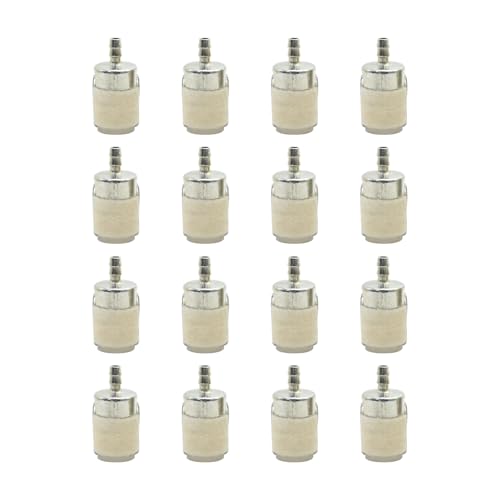

Filter numbers by generation
| Generation | Genuine number | Cross-reference | Models |
|---|---|---|---|
| Current RB/Walbro | 13120507320 | Walbro 125-527 / 125-527-1, also 13120519830 | SRM-210/211/225/230, GT-200/225, PAS-225, PE-200/211, PB-200/250, HC-150/151 |
| Older SRM-200 era | A369000000 | Stens 125-528, also A369000001/A369000070 | SRM-200/210/211/225/230 (earlier production) |
What a clogged filter actually looks like
The filter sits on the end of the fuel pickup line inside the tank, and it clogs from the inside out as varnish from old ethanol fuel builds up on the mesh. A partially blocked filter still passes enough fuel to idle - idle demand is small - but starves the engine the moment the throttle opens and demand rises, exactly the fault profile covered on the won't-start page: starts, runs at idle, dies under load. A fully blocked filter means a no-start instead.
Nothing about the symptom points directly at the tank, which is why it gets missed. The usual order of suspects - stale fuel, then air filter, then the fuel lines and primer bulb, then this in-tank filter, then spark, then carburetor - is worth working through in that sequence rather than guessing, since each step is cheaper to rule out than the next.
Replacing it without draining the whole fuel system
The filter is attached to the end of the fuel line, not fixed to the tank, so it comes out through the fuel cap opening by hooking the line with a bent wire and pulling it clear - easiest with the tank close to empty so the filter and line are easy to see and grab. Pull the old filter off the line, push the new one on until it seats fully, and feed the line back in before it drops to the bottom of the tank.
Because the filter, the fuel lines and the primer bulb all perish on the same schedule rather than wearing with use, tune-up kits bundle all three - replacing one while leaving a hardening line or a cracking bulb in place just means doing the job again within the season. The fuel itself is worth checking too, since stale mix is what leaves the varnish that clogs this filter in the first place.
Frequently Asked Questions
What is the genuine Echo fuel filter part number?
Why does my Echo trimmer idle fine but die when I give it throttle?
Does the Echo fuel filter fit Stihl trimmers too?
How do I know if my SRM-210 or SRM-225 needs the old or new fuel filter?
Do I need to drain the tank to replace the Echo fuel filter?
Ready to check the latest price?
Check Echo Fuel Filters on Amazon